
Design.
A Signature Series Sony WM1 DAPs were introduced in 2 flavors, WM1A and WM1Z. While overall design is similar, each one has its unique elements. With 1Z having a more premium cost-no-object design, it has 256GB of internal memory (vs 128GB offered in 1A), 1Z has more premium internal components (newly developed high polymer FT CAPs and surface mounted Fine Sound Registers), and the four-wire braided Kimber Kable connecting circuit board to headphone jack. But the biggest, and I mean the “biggest” difference is with a chassis material and its corresponding weight.
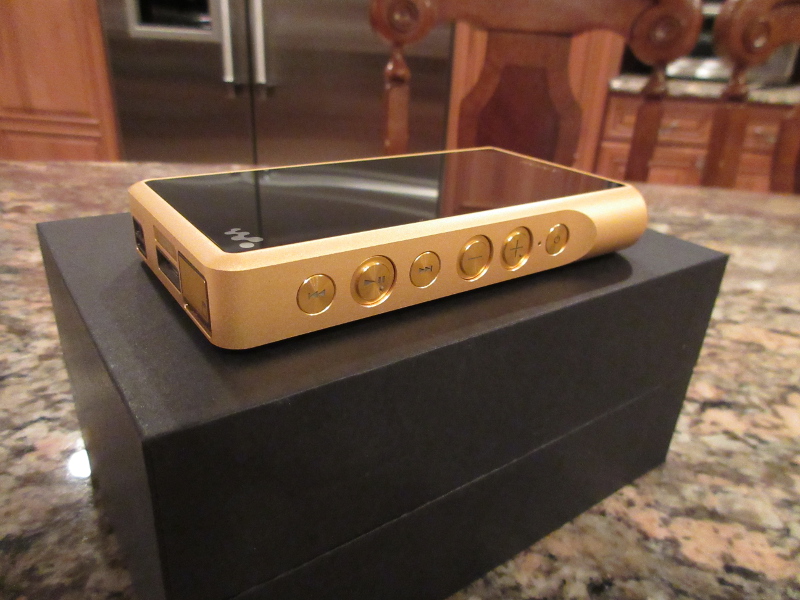
Sony starts by milling chassis from a solid block of pure oxygen free copper (OFC) material, using copper due to its higher density and lower resistance when compared to aluminum material used in 1A chassis. Then, copper material is gold plated to prevent the oxidation. As a result, the chassis of 1Z serve as an extension to the circuit board ground. Since I don’t have access to 1A, I can’t tell you exactly how these DAPs compare, especially due to a difference in selection of internal components and headphone jack wiring. Certainly, aluminum has different electrical properties, including the reduced conductivity. In theory, the ground plane serves as a return path for a power to all the devices on the board, and the higher conductivity of the return path should result in cleaner power and lower noise floor. At the same time, pure copper adds to the weight and the cost when comparing 1A vs 1Z. Thus, you have to consider a trade-off, especially when we are talking about 455g of weight.
With chassis discussion out of the way, the next thing that grabbed my attention was the all glass top display where the visible screen area is 4” with FWVGA 854×480 pixels resolution. It’s a deep color display with black and white high contrast scheme. Besides being able to display rich colors of the embedded artwork (depending on the picture size, since some of the graphics wasn’t displayed), everything else is black’n’white, with an exception of a few labels in yellow. WM1Z has a touch screen with a very responsive display, no lags what to ever in fw 1.2/2.0.
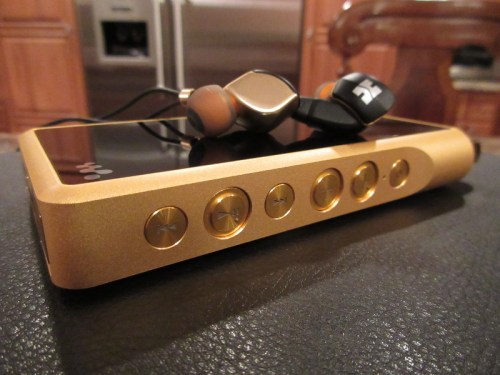
Looking around the chassis, you will find a Hold slider on the left side, to lock the touch screen functionality. On the right side, you have 6 multi-sized hw buttons, with smaller Power button all the way at the top and charging pinhole LED next to it, two larger Volume +/- buttons below it with a distinct bump on the + button for a blind id, and below it 3 transport control buttons with larger Play/Pause in the middle and smaller skip/forward on either side. Play/Pause button also has a bump for a blind id, just slide your finger without looking at the controls and you will be able to easily feel Volume Up and Play/Pause buttons.
These buttons itself are all metal and gold plated, very durable, no shaking or rattling, with a tactile feedback when pressed, and overall solid feel like they are part of the chassis, stamped right into the gold-plated copper. The ergonomics of the design is very impressive. Due to the weight distribution of the 1Z, my thumb was comfortable controlling the Power (for screen on/off) and adjusting the Volume. For transport control buttons toward the bottom of the right side, I had to slide my right hand down and use both hands, with left one for support to make sure I don’t drop the DAP.
Lower left corner of the 1Z bottom has an opening to loop wrist strap, and also a little notch for securing Sony’s leather case. In the middle, you have 22-pin WM port which is proprietary to Sony, and used for charging the DAP, connecting to computer to transfer the files, and also for digital out. No analog Line Out is available, only the digital transport output to drive external DAC/amp. Next to it, in the right corner at the bottom, is the dust cover for uSD port which can accommodate 256GB card and probably the latest 400GB as well. Next to it, you will also find another notch for Sony’s leather case to latch to. The back of 1Z has a leather-textured rubbery non-slip material with NFC marker when pairing wireless headphones, if NFC is enabled.
The top of 1Z has 3.5mm TRRS single ended stereo headphone jack on the right, rated at 60mW+60mW (at 16 ohms), while on the left you have 4.4mm TRRRS balanced stereo jack, rated at 250mW+250mW (at 16 ohms). 4.4mm is a new JEITA standard designed specifically for balanced headphone jacks. It has a number of advantages, such as being mechanically stronger and having a reduced resistance due to larger cross-sectional area of contact. WM1 uses a brand name Nippon DICS Pentaconn (named after 5 contacts) jack where each connection (L+/L-/R+/R-) has 2 points of contact, made into C shape with both sides of the plug engaged, leading to a larger area of contact which results in lower resistance. For additional failsafe, balanced port has a relay switch, making sure you connect headphones all the way in.


Under the hood.
In my DAP reviews, the “under the hood” section usually starts with a discussion about which DAC is used in the design. And often the discussion continuous talking about using dual DACs in higher end models to separate L/R channels. WM1Z is different because Sony has a totally different approach to this design requirement – using their own digital S-Master HX amplifier.
S-Master digital amp is not a brand-new concept, Sony has been using it in a lot of their high-end desktop audio systems throughout years. But they continue to perfect it, to optimize it, and to adapt it for a portable use with their latest in-house developed S-Master HX semiconductor digital amplifier – model CXD-3778GF. This new evolution of S-Master HX digital amp wasn’t only optimized for efficient battery use, but also developed to be compatible with native DSD decoding, Balanced output, and High-Power output. Keep it mind, other entry and mid-fi Sony DAPs, like A40 and NX300, also use CXD-3778GF model, but they have a different implementation of LPF circuit where, for example, A40 uses switching FET inside of CXD-3778GF, while WM1 has high voltage FET outside of the digital amp.
I already mentioned “digital amp” a few times, and would like to talk more about its benefits. In a traditional design, decoded digital data stream is fed into D/A converter for digital signal to be converted into analog, then some Low Pass Filter (LPF), perhaps a volume control, and analog headphone amplifier section. Such traditional design generates “open-loop” distortion which is corrected with a Negative Feedback that has its own problems. Also, with a traditional off-the-shelf DAC architecture design, we see more dual DAC implementations to separate L/R channels in order to reduce the interference and crosstalk.
The problem with this architecture is that majority of the signal goes through analog path which is more susceptible to noise coupling, interference, and crosstalk. Even with L/R channel separation, you are still dealing with a small printed wiring board (pwb) and close proximity of the signals. What S-Master digital amp does is to completely replace the analog amplification with a digital amp technology without a feedback. S-Master doesn’t have D/A converter. Instead, the amp processes the digital signal until the final output stage where it uses LPF.
In a digital domain, there is no need for a dual DAC since you don’t have to worry about analog signal interference and crosstalk, and because this is a fully custom semiconductor design, Sony is in full control to optimize the audio performance (in this case supporting balanced output with DSD native playback in balanced mode only of up to 11.2MHz and Linear PCM playback up to 384kHz/32bit), and also to optimize battery life depending on the audio format playback. When it comes to audio formats, you have support of most of the lossy and lossless formats, such as MP3, WMA, FLAC, Linear PCM (wav), AAC, HE-AAC, Apple Lossless, AIFF, and DSD. CUE files playback is read as a single file. Also, although there is no menu selection to enable gapless, I tested it with one of my gapless MP3 albums and it worked flawless.
Battery life is truly phenomenal, Sony was able to optimize the performance, depending on the file format, to have a playback of over 30hrs. I ran multiple tests with MP3 and FLAC files, using balanced output, and with direct sound on (no DSP effects) and off. On average, my best-case scenario of playing 320kbps MP3 from 4.4mm HO with direct sound yielded 32 hours of continuous playback. Switching to FLAC, playing continuously from 4.4mm HO with DSP effects enabled – lasted 19 hours.

 Twister6 Reviews
Great review. While I think the 1z is crazy in price, from everything I’ve read the 1A sounds similar, with the same excellent soundstage but maybe slightly different color across the spectrum.
I had been wondering about the Cowon Plenue R as a good portable player with good battery life, but then started thinking of spending more for a DX200 (as I’d been impressed with the DX80). But after reading this and the available comparisons between the 1Z and 1A, it looks like the 1A is great value for money, with excellent sound, battery life and GUI.
LikeLike
you definitely have to take into consideration the “diminishing returns” factor. 1Z will have premium components which going to result in fine-tuned sound in comparison to 1A, but the sound quality improvement is not 3x better. A block of pure copper material is VERY expensive, and manufacturing/milling is additional cost… Plenue R I’m familiar with, but some told me ZX300 might be compatible and some say check out AK70mkII as well. Too many choices… I would recommend starting with figuring out your budget first. Then, if you need streaming apps, power requirements, 2.5mm or 4.4mm balanced (depending on your headphones). That would help you to narrow down your selection.
LikeLiked by 1 person
Completely agree – too many choices! You’ve been giving me some advice on the Plenue R thread at head-fi too, and I’m thinking I might just bite the bullet, spend more and avoid further upgrades. Thanks for your input and reviews, very helpful!
LikeLike
Your review of this DAP is really close of what i hear in the AK380, even in the balanced port….in the beggining some people compare it…even the idea of the body material as grounding effect to the sound…what I can’t believe too much, sony takes this thing of body material to a new high level with copper and gold (too much bling for my taste)…in my opinion maybe the difference in sound between 1z and 1a and between AK380 models are caused by different sound tunings and less caused by this premium materials, but i’ts only my opinion…
The Sony ZX2 was a really good sounding android DAP, maybe too analytical or digital, but sounds good (i have it in his time), then the warm-neutral sound leads the ears of the audiophile crowd and sony reacts with this WM1 series…
Your review was very good as always, maybe in the near future I think in a new sony DAP to my collection since the sound description is near to my tastes
Regards
LikeLike
You can’t really compare 1Z to 1A directly, assuming the sound change is due to different chassis material, they use different critical components that will influence the difference in sound. But i did confirm, the circiut ground is connected to the chassis, so you have a better conducting massive ground.
LikeLike
Mmm…you mean the kimber cable vs ofc cable of the internal wiring??….the circuit ground connected to the chasis are the same excuse for AK for the use of different materials (copper ot SS), of course you have better conductivness with this features….and this maybe increase the medible sound quality…
But the difference in sound described by users i think is more akin to sound tunning in both brands, even more with the Sony because it’s already have too much digital sound effects in his DAPs
But to me this is not a bad thing, the quality of the construction and the materials and the different sound tunning will obviously raise the price
LikeLike
no, the copper chassis itself are connected to internal ckt ground, you can check continuity from the ground of headphone jack to copper chassis.
LikeLike
Ok I understand… I don’t want to begin an Apple vs Samsung discussion, i don’t want to bite the hands of the brands that feed my ears…
I don’t want to discuss the internal features of this DAP, i only believe that the tunning of sound differences between WM1 series are more important than the physical differences when we talk about sound coloration and maybe even sound quality …but is only my opinion
Peace 🙂
LikeLike
Did you ever ask sony for wm1a for review?
Would be nice for comparisons with all the other daps you have.
LikeLike
Don’t think they care about 1A review since zx300 sounds very close. So, no with 1A. Plus, it’s getting old already, companies prefer to promote their new or newer releases.
LikeLike
I’m having a hard time hearing a difference between se and balanced to be honest. I was going to go out and get new cables terminated in 4.4 for my iems but i feel that probably not needed.
I mean you could argue the se is “burned in” and the balanced is not if you believe in that. I’ve only tried the balanced today. Maybe i just don’t have great hearing, shrug.
LikeLike
What is your iems/headphones? Do you have the latest 2.x fw? There was a much bigger difference in fw 1.2 between se and bal. Also, depends on how resolving your headphones too, and of course, we all have a different hearing level. Consider it as blessing if you can’t hear a difference, will save you on new cables lol!
LikeLike
I am in love with my Sony NW-WM1A. I use Sennheiser HD650 headphones in balance, as well as Shure SRH1540 headphones. As much as I love it, I’m getting the upgrade bug for the 1Z. I am blown away by how well it drives the 650s. It sounds better than off my Paw Gold Diana, which has much more power. Power alone doesn’t dictate how well a headphone sounds.
LikeLike
don’t have experience with any full size Senns cans, but I can imagine the tonality and the resolution will scale up with 1Z 🙂 I tested ZX300 at canjam, so using that as a baseline because many people tell me that ZX300 is 85-90% in sound quality of WM1A (just going by what others said). To me ZX300 was nice, but had this “digital” coloring. WM1Z sounds like an analog desktop piece of gear. I like SP1000 a lot as well, but 1Z still has this analog tonality like no other daps.
LikeLike
Thanks for the comparison with ZX300, that will probably seal the deal for me for a 1Z
LikeLike
I am thinking about the WM1Z, N8 or LPGT. Any thoughts on the three?
LikeLike
all 3 are good, in their own way. Read my reviews, figure out your own personal Cons and Pros, see which sound you would prefer (especially based on pair up with different earphones and headphones). I know, too many choices 😦
LikeLike
> In high gain, I hear more sub-bass rumble, mids have more body, there is improved layering, better retrieval of details, and treble has more sparkle.
Thank you for putting this in the Review.
That way i instantly new that nothing of this is wroth anything and i can easily forget what i read and look for a more serious review.
LikeLike
You are referring to an ancient 4+ year old review, back when I was getting my feet wet 🙂 But the key point there, wm1z is so underpowered by today’s standards. The balanced output in high gain at maximum volume only has 125mW of power, it is literally a joke by today’s standards. Now, drop it to low gain and depending on a specific pair up synergy with whatever used for testing, it could be night and day in comparison to when you switch to a high gain. Now, 4+ years later and dozens of daps I have tested, wm1z has been surpassed by many.
LikeLike