
Sound Analysis & Comparisons.
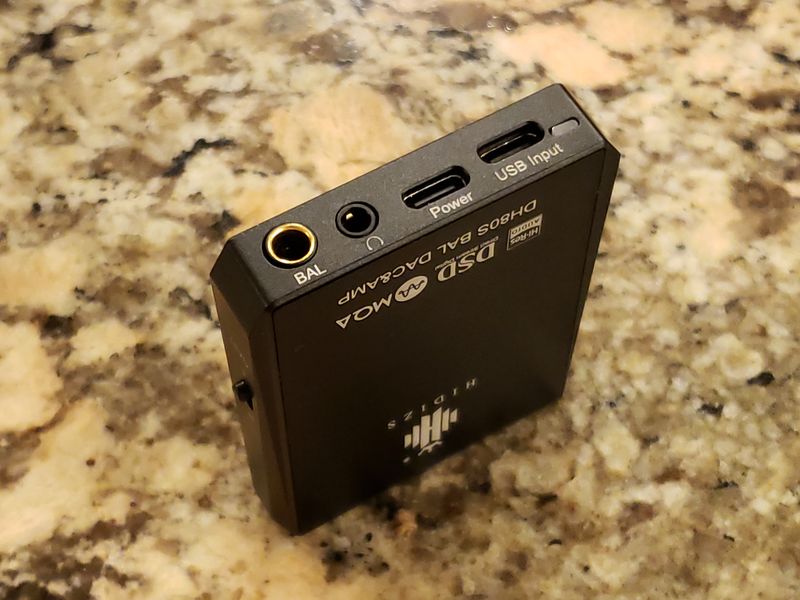
I tested and analyzed Hidizs DH80s connected to my Galaxy S9 smartphone while playing the selection of my usual test tracks, such as Agnes Obel “The curse”, Sandro Cavazza “So much better” (Avicii remix), C-Bool “Never go away”, Ed Sheeran “Shape of you”, Counting Crows “Big yellow taxi”, Galantis “Hunter”, Alan Walker “Darkside”, Iggy Azalea “Black widow”, Indila “Boite en argent”, Robin Schultz “Oh child”, Dua Lipa “Love again”, David Elias “Vision of her”, and Michael Jackson “Dirty Diana”.
In my testing, I hear DH80s to have a neutral natural tonality with a little bit of lift in the low end which adds some weight to the bass and also a touch smoother treble. The overall sound is nicely layered and has expanded vertical dynamics, never felt compressed or congested. Also, I hear a black background, especially in low gain, which results in a pretty good transient response with a very clean on/off note transition. And especially from a balanced output, I hear a very wide soundstage expansion with a precise placement of instruments and vocals.
When you compare SE (3.5mm) vs BAL (4.4mm) outputs, it is quite noticeable to hear a wider soundstage expansion and a blacker background from BAL output.
Comparisons (using Traillii for testing):
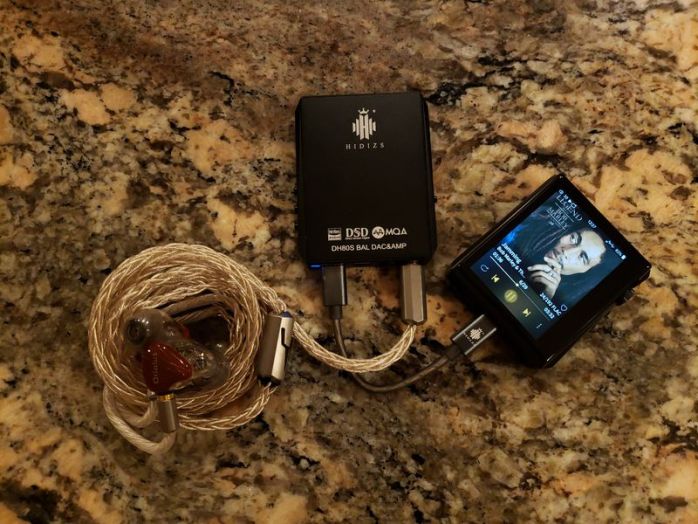
AP80 Pro vs AP80 + DH80s – I was curious about this comparison because the main purpose of Pro version was to add balanced output to the original AP80. The difference here was very noticeable. With DH80s the soundstage is a lot more wider and imaging is approaching 3D holographic level when compared to AP80 Pro version. The tonality becomes more revealing, not brighter but actually more revealing with a much better retrieval of details. Also, the background is blacker, the sound is tighter, with a better layering and improved dynamics. And especially important for me, I didn’t have to use adapters with DH80s to accommodate AP80 Pro 2.5mm BAL jack since most of my cables are 4.4mm terminated.
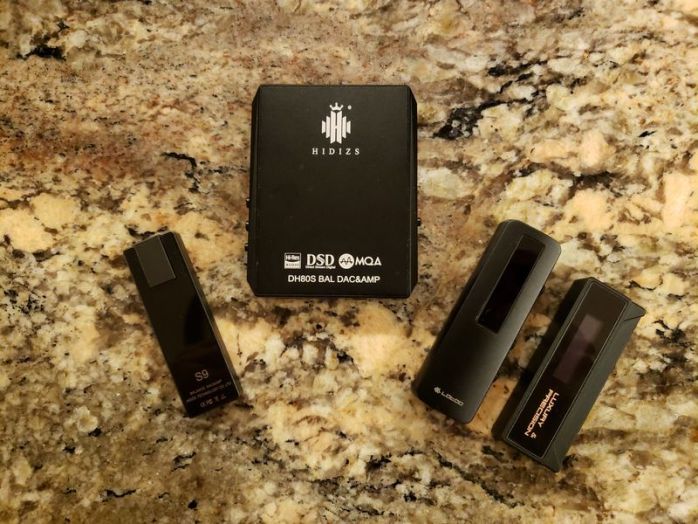
DH80s vs Lotoo S1 – S1 tonality is brighter in treble (crisper), and it has not as black background as DH80s. Overall, S1 sound is not as tight and a little more compressed in dynamics when compared to DH80s. Both have volume and gain adjustment that was quite useful, and you have to keep in mind that S1 is usb/dac dongle without a battery.
DH80s vs L&P W2 – W2 has a little deeper bass and crisper treble, slightly wider soundstage, but the background is as black and the sound is as tight. With an exception of tonality difference, the technical performance was similar. Both have volume and gain adjustment that was quite useful, and you have to keep in mind that W2 is usb/dac dongle without a battery.
DH80s vs Hidizs S9 – S9 has a more elevated bass, mids are pushed a little back, HD80s dynamics is more expanded which makes S9 sound a bit compressed relative to HD80s. No volume or gain adjustment in S9.
Pair up notes (just a few):
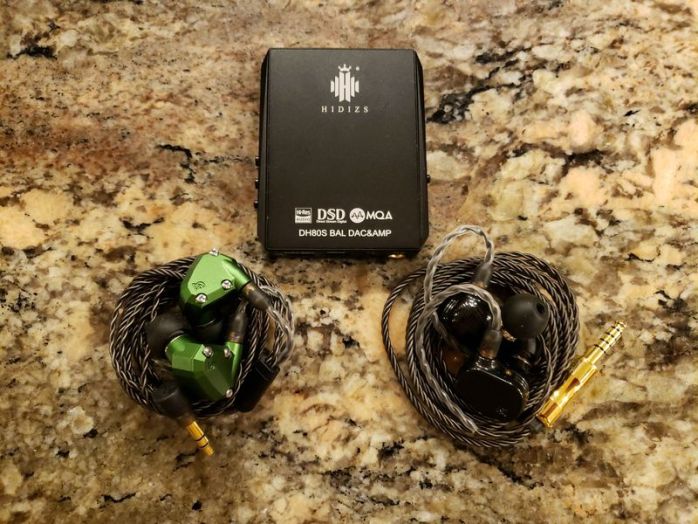
Campfire Audio Solaris/Andro (4.4mm) – I find using these sensitive iems frustrating with some other dongles (and DAPs) due to hissing. Here, after switching to low gain, hissing was hardly noticeable.
Audio-Technica ATH-R70x (470ohm, 3.5mm) – since I only have SE cable for R70x I had to drive it from less powerful 3.5mm output, and to make it loud enough I had to set my phone and DH80s to max volume. This is an extreme case, but I was still curious, even so it wasn’t the best pair up because the sound was too smooth. As expected, demanding headphones might not be a good match for DH80s.
Meze Audio Empyrean (planar magnetic, 4.4mm) – I do have a balance cable for Empyrean and I was able to drive them loud enough at max volume of HD80s, though found the sound to be a bit smooth as well, and the bass lost its punch.
I did find DH80s to pair up great with IEMs, anything I tried from single DD to multi-BA and hybrids sounded as good as pair up with many other mid-fi DAPs. Also, less demanding headphones paired up great, but not so much when you try demanding high impedance/low sensitive or planar magnetic ones.
Conclusion.
As I was wrapping up this review, I clicked on Hidizs link to check something and noticed they have DH80s on sale for $119, down from the original $139 price. That made me think of how far some audio gear manufacturers have come and how little you have to pay to get a decent sounding audio source. Perhaps not as compact as S1 or W2, DH80s sound quality is on the same level, making it a great companion for your smartphone, tablet, or laptop. But aside from sound quality, there were a few very important factors that made this balanced portable DAC/amp stand out for me.
It is very friendly with sensitive IEMs when you switch to low gain, hardly any hissing. You have the convenience of a popular 4.4mm BAL output. The built-in battery doesn’t drain your phone and allows higher volume without iPhone’s 100mA dreadful external device limitation. Unlike usb-dac dongles, you do have to charge this one, but a separate charging port will allow that while still using DH80s. And last, but not least, independent volume control gives you finetuning of the volume in addition to your phone or laptop own volume control. My only wish would be to have remote playback controls, maybe one of these days.

 Twister6 Reviews
Greetings
Do i have to Charge ap80 and dh80s seperate?
Or do does the dh80s Charge the ap80 while connectet
LikeLike
it has its own battery, so it shouldn’t be draining ap80 battery when connected. You have to charge DH80s separately, the reason why it has 2 usb-c ports, one for digital audio in connection and another one for charging.
LikeLike
Can U try to Change ap80 Setting From audio to USB Dock Mode and look If the dh80s ist charging the ap80 than,because If not that would be a big con for me
LikeLike